Shadow: Five Presidents And The Legacy Of Watergate by Woodward Bob
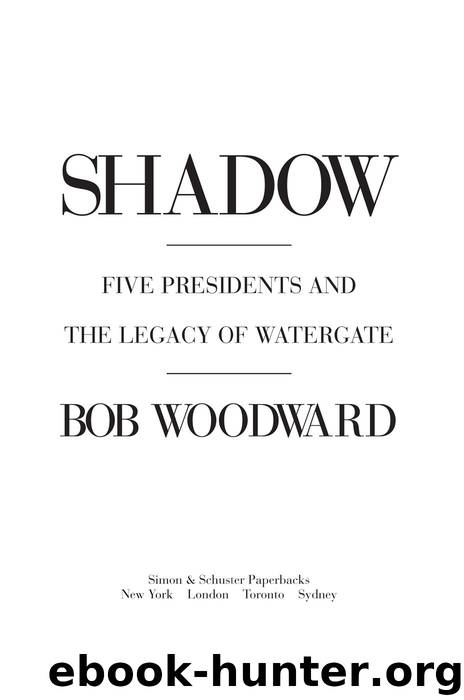
Author:Woodward, Bob [Woodward, Bob]
Language: eng
Format: epub
Publisher: Simon & Schuster
Published: 1999-06-16T00:00:00+00:00
26
SIX WEEKS before the election, September 23, 1996, Clinton gave an interview to Jim Lehrer for his public television NewsHour. Lehrer asked, Did the president agree with Susan McDougal, his former Whitewater partner who was refusing to testify, that Starr was out to get the Clintons?
Clinton replied that Susan McDougal and her attorney claimed that Starr and his attorneys urgently wanted to find something incriminating about the Clintons. “They wanted her to say something bad about us, whether it was the truth or not,” he said. “And if it was false, it would still be perfectly all right.”
Asked if he believed that, Clinton said, “There’s a lot of evidence to support that.”
“But do you personally believe that’s what this is all about, is to get you and Mrs. Clinton?” Lehrer asked.
“Isn’t it obvious?” the president replied.
“You obviously believe that, right?”
“Isn’t it obvious?” Clinton repeated.
Asked about a possible pardon for Susan McDougal, Clinton said he had given no consideration to it but also said it would have to be handled through routine Justice Department channels for pardons.
When Starr saw Clinton’s words, he felt cut deeply and personally. The idea that he would encourage or knowingly accept—suborn—perjured testimony was outrageous. On a more practical front, Clinton seemed to be holding out the promise of a possible pardon to Susan McDougal, who two weeks earlier had refused to testify before the grand jury and had gone to jail under a contempt charge.
Starr was as angry as some of his key deputies had ever seen him. The president had accused the independent counsel of egregious ethical and even criminal misconduct. Starr wanted a retraction from Clinton, and he felt the president should publicly encourage Susan McDougal to testify at once and truthfully. Starr was almost fulminating on the issue. He directed that a letter be written to the White House counsel. In all, Starr sent five letters on this topic to the White House.
• • •
In September, the first newspaper stories appeared about large foreign campaign contributions to the Democratic National Committee. A number of the contributions were connected to the Lippo Group, the Indonesian conglomerate owned by the Riady family. James Riady had made about 20 visits to the White House since Clinton was elected and had continued to pursue close ties with his old friend the president.
Sherburne and Fabiani had known for more than a year that The New York Times was asking some questions about money, apparently $100,000 that Riady had given to Webster Hubbell. The payment had been made to Hubbell after he had resigned from Justice but before he had plead guilty to bilking his former partners, including Hillary, and clients of $400,000.
The matter was explosive, Sherburne and Fabiani had realized for some time. Hubbell was the nexus of Bill Clinton, Hillary Clinton, the Rose Law Firm, their Arkansas past and the first year of the Clinton Justice Department when he had been the number three official. Starr and his investigators believed Hubbell could provide damaging testimony, and they
Download
This site does not store any files on its server. We only index and link to content provided by other sites. Please contact the content providers to delete copyright contents if any and email us, we'll remove relevant links or contents immediately.
| Anthropology | Archaeology |
| Philosophy | Politics & Government |
| Social Sciences | Sociology |
| Women's Studies |
The Secret History by Donna Tartt(19090)
The Social Justice Warrior Handbook by Lisa De Pasquale(12190)
Thirteen Reasons Why by Jay Asher(8912)
This Is How You Lose Her by Junot Diaz(6887)
Weapons of Math Destruction by Cathy O'Neil(6281)
Zero to One by Peter Thiel(5802)
Beartown by Fredrik Backman(5755)
The Myth of the Strong Leader by Archie Brown(5508)
The Fire Next Time by James Baldwin(5447)
How Democracies Die by Steven Levitsky & Daniel Ziblatt(5219)
Promise Me, Dad by Joe Biden(5154)
Stone's Rules by Roger Stone(5088)
A Higher Loyalty: Truth, Lies, and Leadership by James Comey(4964)
100 Deadly Skills by Clint Emerson(4926)
Rise and Kill First by Ronen Bergman(4789)
Secrecy World by Jake Bernstein(4753)
The David Icke Guide to the Global Conspiracy (and how to end it) by David Icke(4720)
The Farm by Tom Rob Smith(4514)
The Doomsday Machine by Daniel Ellsberg(4490)
